


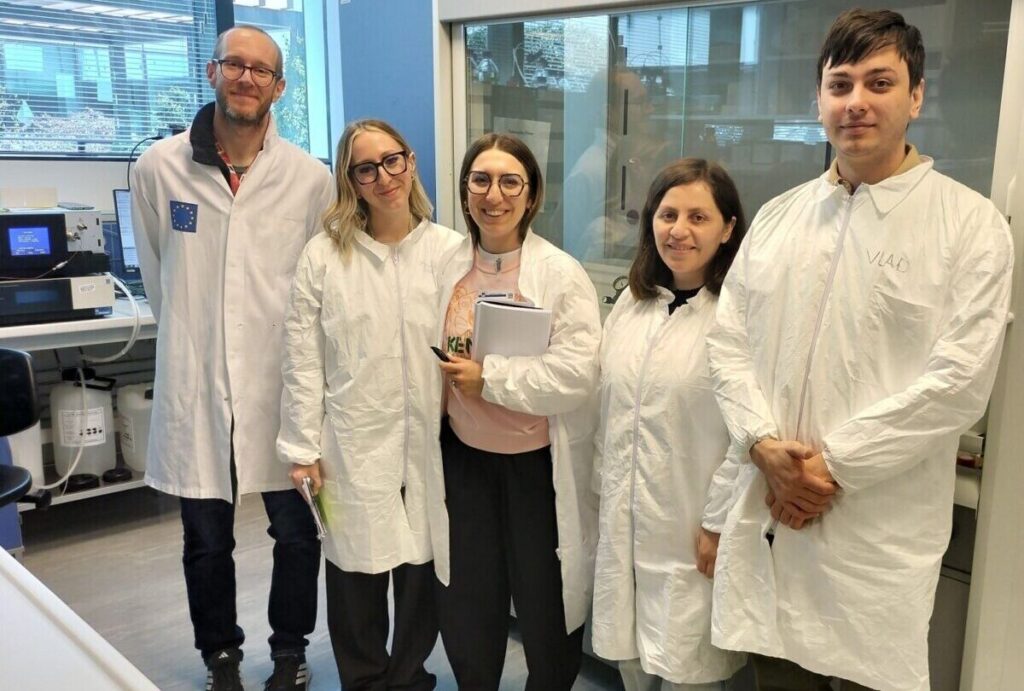
From March 23 to 27, Vladyslav Berezovskyi, a third-year PhD student of the Department of Biochemistry and Biotechnology at the Faculty of Natural Sciences, participated in the 5th Training & Capacity-Building Week, held at the Nanobiotechnology Laboratories of the Joint Research Centre (JRC) of the European Commission in Ispra, Italy.
The event brought together representatives of 24 projects from 26 research institutions across 16 countries, including EU Member States and Horizon Europe-associated countries. The training programme covered key areas of modern biomedical and nanotechnology research, including nanomaterials in food systems, 3D bioprinting, nanomedicine, and micro- and nanoplastics research.
During the intensive hands-on training, the participant worked under the supervision of leading JRC experts and gained practical experience with a range of advanced analytical and experimental techniques essential for cutting-edge research:
- lipid nanoparticle (LNP) synthesis using microfluidic technologies;
- AF4-DLS for size separation and characterization of nanoparticles;
- cryogenic transmission electron microscopy (Cryo-TEM) for high-resolution imaging of nanostructures in their native hydrated state;
- HPLC-CAD for quantitative analysis of non-volatile compounds;
- surface plasmon resonance (SPR) for real-time analysis of molecular interactions;
- hydrophobicity assessment using dark-field microscopy.
In addition to laboratory work, the programme included institutional presentations, poster sessions, and discussions on access to advanced European research infrastructures.
Particular emphasis was placed on open access opportunities to high-end research facilities. Participants were introduced to the JRC as the European Commission’s science service, as well as to the CERIC-ERIC consortium, which provides access to over 50 state-of-the-art research infrastructures across Europe.
Participation in such international training programmes represents an important step toward integrating the university into the European Research Area. The acquired knowledge and skills contribute to the development of innovative research, strengthen international collaboration, and enhance the competitiveness of early-career researchers.